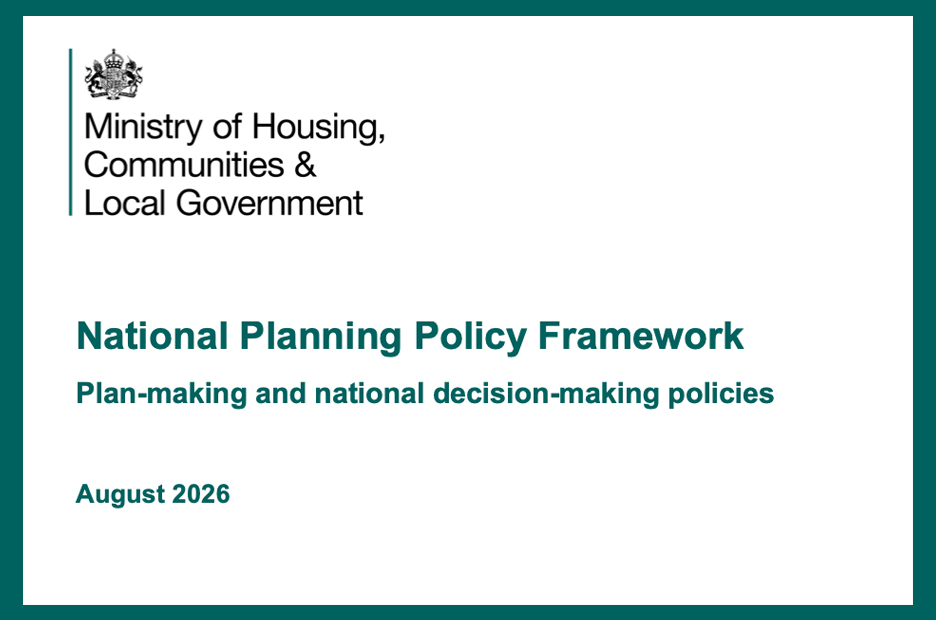
New NPPF offers stronger support for rural exception sites
New planning rules offer a stronger foundation for rural affordable housing
The Government’s new National Planning Policy Framework (NPPF) rules for rural exception sites bring welcome recognition of their role in providing affordable homes for local people.
Published on 17 August, the new Framework is a substantial rewrite of national planning policy. It separates the policies used to prepare local plans from those used to decide planning applications, with the aim of creating a clearer and more rules-based system.
For Cambridgeshire’s rural communities, this matters. High house prices and a limited supply of genuinely affordable homes mean that people can be forced to leave the villages where they grew up, work or have family connections. Schools, shops, services, community buildings and local businesses all depend on villages retaining a balanced population.
Rural exception sites allow land outside the areas normally allocated for housing to be developed specifically to meet an identified local need for affordable homes. Used well, they can provide homes for people with a genuine connection to the parish and protect those homes as affordable housing for future generations.
But rural exception sites should remain genuinely exceptional.
“Exceptional” should not mean that affordable housing is delivered only rarely. It should mean that development outside normal settlement boundaries is justified by clear local evidence, remains proportionate to the place and delivers lasting affordable homes for people with a genuine local connection.
What the new NPPF rules mean for rural exception sites
The new Framework provides welcome clarity. Unless the development plan provides otherwise, rural exception sites should normally adjoin or be physically well related to an existing settlement and be no greater than one hectare or 5% of the size of that settlement, whichever is greater.
They must include affordable housing which meets identified local need. Market housing should only be included where it is essential to make the affordable homes deliverable without grant funding.
The Framework also recognises community-led housing as another route through which local needs may be met. Whether homes are delivered by a registered provider, through a community-led model or through partnership working, proposals should be evidence-led, proportionate and capable of securing affordable homes for local people over the long term.
Our own evidence shows the scale of the challenge. In 2025/26, Cambridgeshire ACRE’s Housing Needs Surveys identified a need for 175 affordable homes across eight rural communities. During the same year, 53 affordable homes were completed through schemes supported by the Cambridgeshire Rural Affordable Housing Partnership. This demonstrates both the continuing level of unmet need and what can be achieved through sustained local partnership working.
Recognising the value of housing needs surveys
One of the most significant changes for our work is the explicit recognition given to housing needs surveys.
The Framework states that local housing need can be evidenced through a housing needs survey or secondary data that is no more than five years old. This is a welcome endorsement of the value of current, independent local evidence.
A housing needs survey does not commit a parish to development. It establishes whether local people need affordable housing and, if so, the number, size and type of homes required. It enables parish councils, local authorities and housing providers to consider possible solutions from an informed starting point.
Our experience at Cambridgeshire ACRE shows that the strongest schemes begin with evidence and involve communities from the outset. Our Rural Housing Enablers work independently with parish councils and residents, before supporting discussions with local authorities, landowners and registered providers.
We are also pleased that the Government has retained onsite affordable housing requirements for medium-sized developments. These sites provide a significant proportion of affordable housing in rural areas, so allowing developers to replace onsite homes with financial contributions could have reduced the number delivered in the communities where they are needed.
The wider rural picture
The new Framework matters to rural communities for more than housing alone. Decisions about where development takes place need to consider whether transport, water and wastewater infrastructure, schools, health services and community facilities can support both new and existing residents. In rural areas, where services may already be limited or distant, development should help strengthen a community rather than increase pressure on infrastructure without providing the investment needed.
The Framework’s approach to the rural economy, digital connectivity, flood risk, biodiversity and climate resilience will also be important in Cambridgeshire. Villages need homes, but they also need local employment, reliable infrastructure, accessible services and places where people can meet and participate in community life. Good rural planning should consider these issues together rather than treating housing numbers in isolation.
There is still work to do. Greater clarity is needed about how Permission in Principle should apply to rural exception sites, including how affordable housing and tenure requirements can be secured from the outset. It will also be important that future Spatial Development Strategies recognise rural areas as living communities with social and economic needs, not simply as locations for environmental action or development serving neighbouring urban areas.
Planning policy alone will not resolve the rural housing crisis. Delivery still requires suitable land, willing communities, committed housing providers, adequate infrastructure and sufficient funding. Nevertheless, the new Framework provides a stronger foundation for delivering affordable homes which are supported by evidence and appropriate to the communities they serve.
That is a positive step for rural Cambridgeshire.
Learn how Cambridgeshire ACRE’s Rural Housing Enabler service can help your community identify and address local affordable housing need or contact Gary Roffey on 01353 865031 or at gary.roffey@cambsacre.org.uk, or Russell Moore on 01353 865040 or at russell.moore@cambsacre.org.uk.

